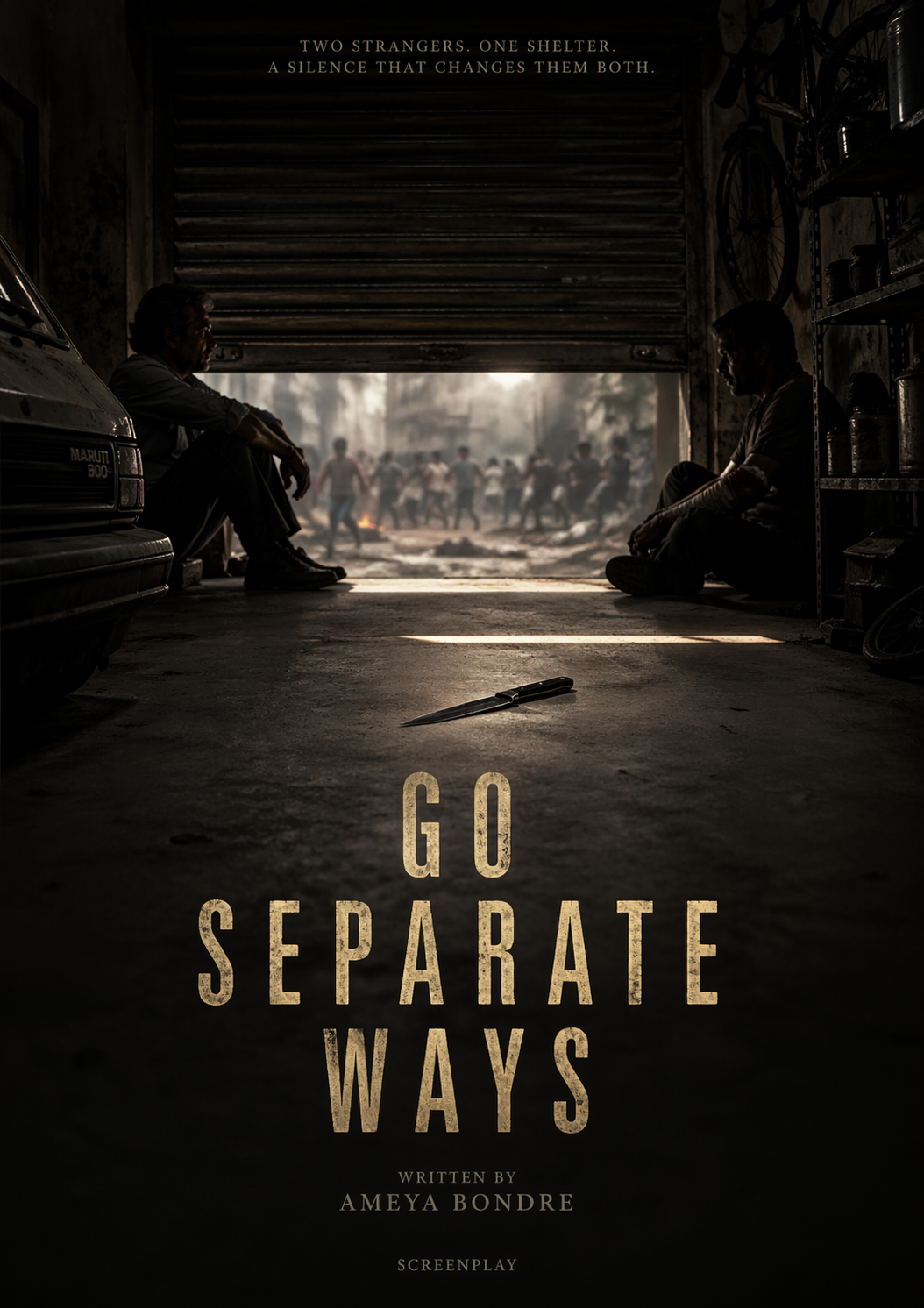
A communal riot tears through the narrow lanes of a small town in northern India in 2013. Smoke rises. Crowds scatter. Slogans bleed into each other, indistinct - the specific words lost in the texture of collective violence. The ordinary world turning on itself.
Through this chaos moves a man. Late forties, stout, grey shirt, dark trousers. He is not fleeing the mob - he is moving through it with terrible purpose, a knife held low against his thigh. His eyes scan doorways and windows. He is searching for someone. His daughter - twelve years old - was burned alive that morning at the market near the station. His wife witnessed it from a distance, helpless. He carries with him, in his trouser pocket, a small plastic earring case - modest, bright earrings from a street stall. His daughter had asked for them three weeks ago. He kept forgetting. Lost in his own fury, wrong turn after wrong turn, he notices a gap under a corrugated iron garage shutter. Police sirens are closing in. He crouches and squeezes through.
Inside: darkness, engine oil, rust, a battered 'Maruti 800' car, a child's bicycle hanging dusty on the wall. The man rises, catches his breath - and sees another man already there. Thirties, lean, a cut on his forearm bleeding slowly. A stranger from the same streets, hiding from the same violence. Neither speaks. Neither asks the question that would require an answer in return - because both men understand that in this garage, that question changes everything.
They settle into opposite corners. The knife rests on the floor equidistant between them. Outside, the mob sounds shift, closer then farther. The two men hold their silence. Time passes. The light through the shutter gap softens. The man looks at his hands - calloused, ordinary hands that have been carrying a knife through burning streets. He reaches into his pocket and withdraws the earring case. He holds it in both palms the way you hold something you cannot carry and cannot put down. And then the words simply leave him – released. His daughter. Twelve years old. The market. The fire. The earrings he kept forgetting to buy.
The other man does not move. His eyes fill. He offers nothing - no absolution, no equivalence, no argument. Only the fact of being human, and present, and hearing this.
As dusk turns the light golden, the other man checks the street and declares it safe. He will go first. The man should go the other way. They cannot be seen walking together. The world outside is still the world outside. The other man slides under the shutter and disappears. The man sits alone with the earrings in his hand and the knife.
He does not take the knife. He slides under the shutter into the empty street, looks left, looks right, and begins to walk. We do not see which direction he chooses.